Copper vs Stainless Steel Still for Vodka
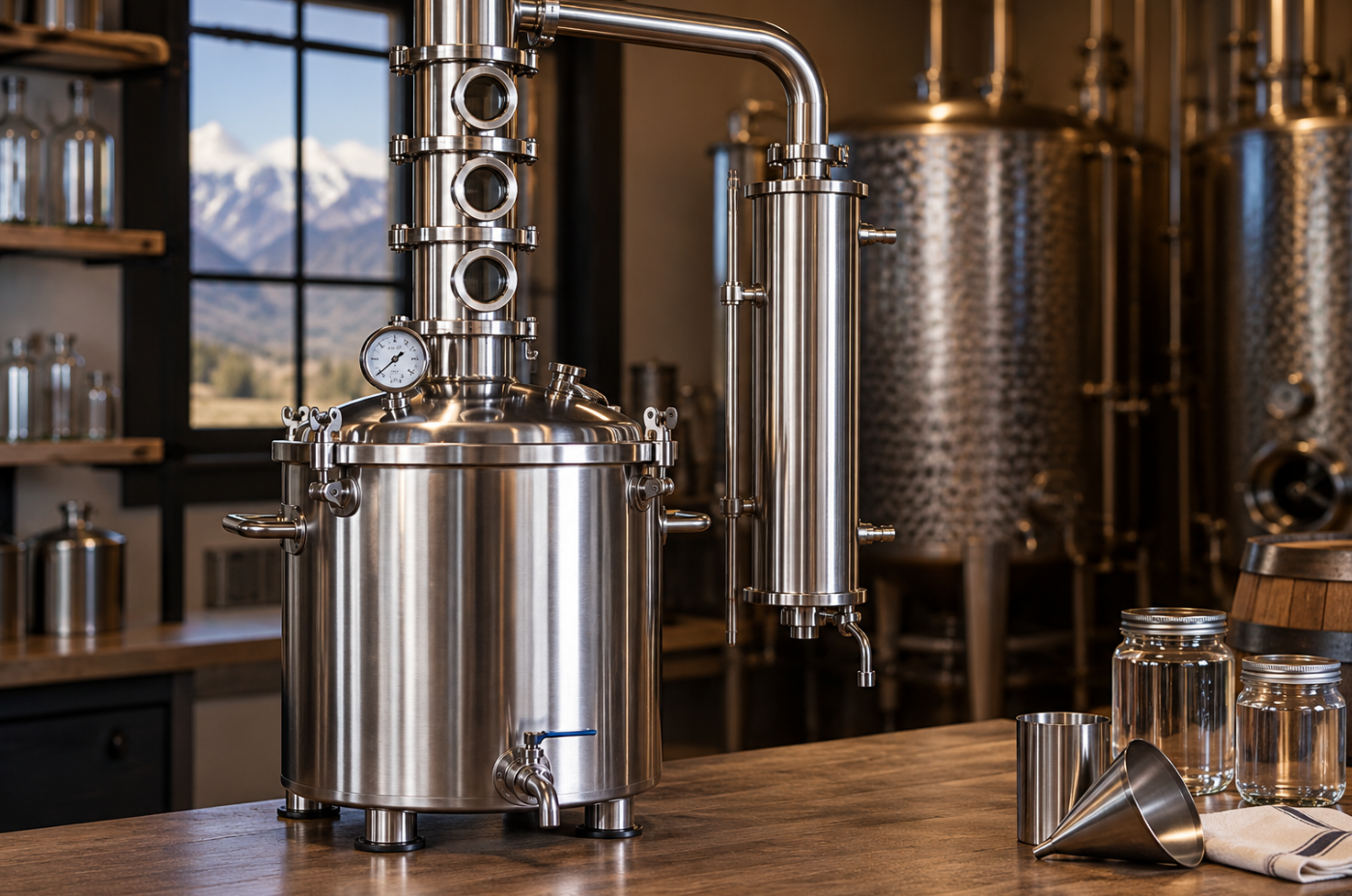
For vodka, a stainless steel still is usually the better choice, as long as it has some copper in the vapor path. Vodka is all about neutrality: high proof, clean flavor, and as little character from the grain as possible. That means the design of your column matters far more than the metal it’s made from. A stainless reflux still with copper packing gives you the proof, the clean taste, and the easy cleaning that vodka calls for.
Here’s how copper and stainless compare for vodka, and what actually makes a still good at neutral spirits. For the full comparison across every spirit, see our copper vs. stainless steel stills guide.
Is copper or stainless steel better for a still for vodka?
Stainless steel is better for a vodka still in most cases. Vodka needs a tall, sealed reflux column with plates or packing, and stainless handles that best: its tri-clamp fittings seal tightly, it’s cheaper at column heights, and it’s easy to clean between runs. Copper stills can make vodka too, but you pay extra for flavor-shaping qualities that a vodka run strips away anyway. The one thing stainless can’t do is remove sulfur, which is why copper packing belongs in the column.
What is the best still for making vodka?
The best still for making vodka is a reflux or column still that can reach about 95% ABV. U.S. federal rules define neutral spirits, the category vodka falls under, as spirits distilled at or above 95% alcohol by volume (190 proof). (1) A simple pot still can’t reach that in a single run. A reflux still can, which is why it’s the standard tool for vodka at every scale, from home setups to large distilleries.
How reflux and column design affect neutrality
Inside a reflux column, rising vapor meets liquid that is condensing and falling back down. Each time that happens, the vapor gets richer in ethanol and leaves more of the heavier flavor compounds behind. The more of these exchanges a column can create, the purer and more neutral the spirit coming out of it.
Three things control this: column height, the plates or packing inside, and how much vapor you send back down as reflux. A taller column with more plates or packing produces a cleaner, higher-proof spirit. Clawhammer Supply founder Kyle Brown notes that vodka “is best distilled in vessels with a reflux column,” since the process is faster that way.
Height beats metal. For vodka, a tall, well-packed stainless column will outperform a short copper one every time. Spend your budget on column design first, and material second.
What copper contact adds to a stainless steel system
Copper adds one thing stainless can’t: sulfur removal. Yeast produces sulfur compounds during fermentation, and copper reacts with them in the vapor path, removing harsh, eggy off-notes. Scientists studying new-make spirit have linked drops in certain sulfur compounds to contact with copper in the still. (2)
You don’t need much. Brewhaus points out that even a small amount of an all-copper column packing is enough to remove those sulfur compounds. Copper mesh or scrubbers in the column also add surface area for reflux, so they help with purity too. Learn how to set this up in our guide to copper packing in a stainless steel still.
Replace your copper, not your still. Copper packing slowly wears away as it reacts with sulfur. When it turns dark or starts breaking apart, swap it out. A new bag of mesh costs a fraction of a copper column.
Copper stills for vodka
Pros: built-in sulfur removal, excellent heat conduction for fast adjustments, and a traditional look.
Cons: expensive at the column heights vodka needs, harder to clean, and many copper stills use friction-fit or flour-paste joints that can’t hold the slight pressure bubble plates require. See the full list of copper still pros and cons.
Stainless steel stills for vodka
Pros: lower cost, strong and long-lasting, easy to clean, and sealed tri-clamp connections that work with bubble plates, sight glasses, and tall packed columns.
Cons: no sulfur removal on its own, and slower response to heat changes. Adding copper packing solves the first problem. Read more about stainless steel still pros and cons.
What does Tito’s make their vodka with?
Tito’s makes its vodka from corn and distills it six times. The brand started out making vodka in copper pot stills at Texas’s first legal distillery, and today it operates a large facility with 10 floor-to-ceiling stills. (3)
Tito’s shows that pot stills can make vodka, but only with many repeat distillations. A reflux column does the work of multiple distillations in a single pass, which is why it’s the practical choice for most distillers.
Does distilling vodka more times make it better?
Not necessarily. Each distillation raises the proof and removes more unwanted compounds, but a good reflux column can reach neutral-spirit proof in one run. Grey Goose, for example, distills its vodka only once. For a clean vodka, a healthy fermentation, careful cuts between the heads, hearts, and tails, and good column design matter more than the number of runs.
Is home distilling legal now in the USA?
Home distilling is still illegal under federal law in most of the U.S. (last updated September 2026). In April 2026, the Fifth Circuit struck down the federal ban, but only for Texas, Louisiana, and Mississippi. The Sixth Circuit upheld the same ban eleven days later. Both cases have been appealed to the Supreme Court, but the justices have not yet agreed to hear either one. (4) In Colorado and most other states, the federal ban still applies, and state laws remain in force everywhere. Check both federal and state law before distilling.
Final verdict
For vodka, choose a stainless steel reflux still with copper packing in the column. You get the high proof and neutral flavor vodka requires, easy cleaning, and sulfur removal where it counts, at a lower cost than an all-copper still. If you want a still that can also make flavorful spirits, see how the choice changes in our guide to copper vs. stainless steel stills for whiskey, or start with our complete copper vs. stainless steel stills comparison.
References
- Standards of Identity for Distilled Spirits, 27 CFR Part 5 Subpart I, Electronic Code of Federal Regulations, https://www.ecfr.gov/current/title-27/chapter-I/subchapter-A/part-5/subpart-I
- Influence of Different Fermentation Conditions on the Aroma-Active Compounds During New-Make Whisky Production, PMC (National Institutes of Health), https://pmc.ncbi.nlm.nih.gov/articles/PMC13305191/
- Tito’s Vodka, Wikipedia, https://en.wikipedia.org/wiki/Tito%27s_Vodka
- Fifth and Sixth Circuits Divided on Whether the Necessary and Proper Clause Authorizes Federal Ban on At-Home Spirit Distilling, Congressional Research Service, https://www.congress.gov/crs-product/LSB11459